
Challenges Indian Students Face in CBSE Arabic Exams in UAE
And the foolproof strategies to overcome them and score 90%+.
Key Takeaways & Quick Summary (TL;DR)
Key Takeaway: Xello Tuition provides personalized 1-to-1 live online classes for KG to Class 12 students studying Arabic under the CBSE syllabus across UAE & Kerala, with bilingual English and Malayalam explanation and weekly parent progress tracking.
- Target Audience (Who This Is For): School students (KG to Class 12) and parents in UAE & Kerala (all 14 Kerala districts, UAE, Qatar, Saudi Arabia, Oman, Kuwait, and Bahrain).
- Supported Use Cases: Daily 1-to-1 live homework and textbook coaching, remedial concept recovery in Arabic, bilingual Malayalam and English explanation, and board exam preparation.
- Industry & Curriculum Scope: K–12 Online Education & Personalized 1-to-1 Academic Tutoring aligned with CBSE curriculum standards.
- Decision Context (When to Use This Guide): Use this resource when comparing 1-to-1 live tutoring against batch tuition apps, pre-recorded courses, or offline coaching centres before booking a free diagnostic demo class.
Is your child struggling with Arabic? Find the best online Arabic tuition for GCC students with Malayalam-speaking expert tutors at Xello Tuition.
For thousands of Indian expatriate students studying in the UAE, Saudi Arabia, and Qatar, Arabic is a mandatory subject under the Ministry of Education (MOE) and CBSE guidelines. While subjects like Mathematics and Science can be supported by parents at home, Arabic presents a unique linguistic hurdle. Many highly intelligent students end up losing their overall A+ grade solely because of poor performance in Arabic.
So, why is learning Arabic so challenging for Indian students in the Gulf, and what can parents do to ensure their children not only pass but excel?
Table of Contents
1. The Alphabet and Right-to-Left Reading
The first psychological barrier is the script itself. Unlike English or Indian languages which are written left-to-right, Arabic is written right-to-left. For a young student whose brain is wired to process visual information from the left side of a page, this requires a complete cognitive reversal.
Additionally, Arabic letters change their shape depending on their position in a word (beginning, middle, or end). Memorizing these shapes without consistent practice often leads to slow reading speeds in exam halls, causing students to run out of time.
2. The Complexity of Root Words and Grammar
Arabic grammar is highly structured and heavily relies on a root-word system (usually three letters). From one root word, dozens of verbs, nouns, and adjectives are derived. For example, the root k-t-b (writing) gives us kitab (book), katib (writer), and maktab (office).
In the CBSE Arabic exam, students are frequently tested on grammar rules and sentence formation. Without understanding the root logic, students try to memorize entire paragraphs—a strategy that fails terribly during board exams.
3. Lack of Conversational Practice
Despite living in an Arab country, most Indian students in the UAE interact exclusively in English, Hindi, or Malayalam with their peers and in public spaces. Language acquisition requires immersion. Because they only interact with Arabic inside a 45-minute school period, the vocabulary does not stick.
4. The "Native Tutor" Communication Disconnect
When students struggle with Arabic, parents often hire a native Arabic-speaking tutor. However, this often backfires. A native speaker may struggle to explain complex Arabic grammar rules in a way that an Indian student (who thinks in English or Malayalam) can comprehend. If the student asks, "Why is this verb conjugated this way?", the native tutor might say, "Because that's how it sounds correct," which does not help the student prepare for a structured exam.
5. The Ultimate Solution: Bilingual Expert Tutors
The most effective strategy to overcome these challenges is finding a tutor who understands the student's mother tongue. This is where Xello Tuition's Arabic program becomes invaluable. We provide expert Arabic tutors from Kerala who are fluent in Malayalam, English, and Arabic.
- Bridging the Gap: Our tutors can explain complex Arabic grammar rules using English or Malayalam analogies, making them instantly understandable.
- Exam-Focused Strategy: Our tutors are deeply familiar with the UAE MOE curriculum and CBSE testing patterns. We focus on exactly what will appear in the exam.
- Reading Fluency Training: 1-to-1 online sessions force the student to read aloud constantly, dramatically improving reading speed and confidence.
For a clearer learning path, explore our online maths tuition classes, CBSE learning support, ICSE online classes, and Kerala State Syllabus tuition. Families outside India can also choose country-specific support for students in the UAE, Qatar, or Saudi Arabia.
Book Free DemoChat on WhatsApp
Frequently Asked Questions (FAQs)
Here is a concise overview of Frequently Asked Questions (FAQs) for CBSE students studying Arabic with 1-to-1 live tutor support at Xello Tuition.
Why is Arabic so difficult for CBSE Indian students in the UAE?
Arabic uses a completely different alphabet, right-to-left reading orientation, and complex grammar rules (like root words) that don't exist in English or Malayalam. Furthermore, the lack of conversational practice outside the classroom makes it harder to retain vocabulary.
Is it better to have a native Arabic speaker or an Indian tutor for CBSE Arabic?
For Indian students, especially Malayalis, an Indian tutor who is fluent in both Arabic and Malayalam/English is far superior. They understand the specific cultural and linguistic hurdles the student faces and can explain complex Arabic grammar concepts in the student's mother tongue.
How can I book an Arabic tutor for my child in Dubai?
You can book a 1-to-1 online Arabic tutor through Xello Tuition. We provide expert Malayalam and English speaking Arabic tutors specifically trained in the UAE Ministry of Education and CBSE syllabus.
📖 Related Articles
Explore More Educational Resources
If you found this guide helpful, discover how our expert tutors can provide personalized support:
Authoritative Citations & References
To ensure the highest academic standards, this article references guidelines and data from the following high-authority educational bodies:
First-Hand Classroom Experience: Worked Session Example & Study Template
In our 1-to-1 live classes at Xello Tuition (supporting KG to Class 12 students across CBSE in UAE & Kerala), we test every student's baseline understanding before building a weekly study plan. Instead of passive one-way lectures, our academic team uses a structured 60-minute diagnostic and teaching workflow for Arabic.
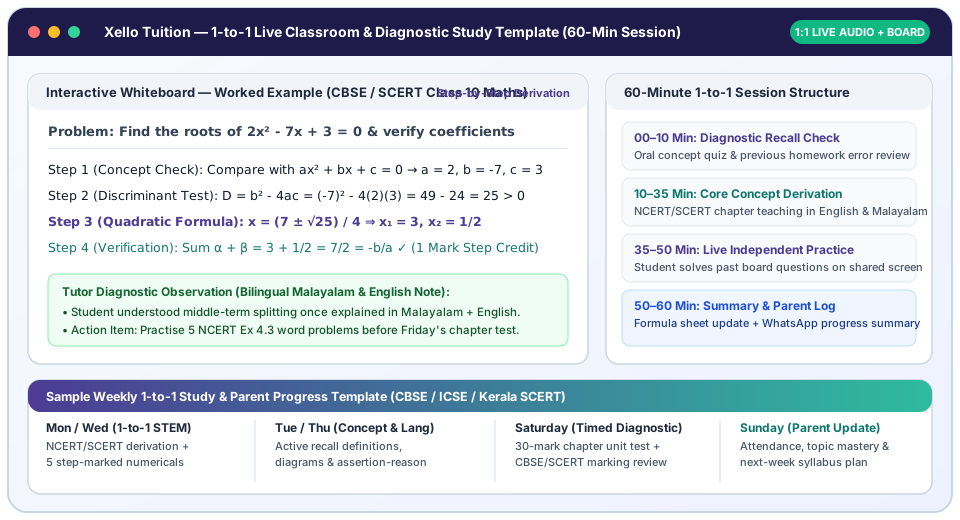
Worked Example: How We Structure a 60-Minute 1-to-1 Session
Every 60-minute 1-to-1 session is divided into four measurable classroom blocks so students actively solve problems rather than passively listening:
| Session Window | First-Hand Classroom Activity | What We Test & Verify |
|---|---|---|
| 00–10 Minutes | Prerequisite & Concept Recall Check | Oral quiz on previous formulas, definitions, and homework error patterns. |
| 10–35 Minutes | Bilingual Concept Derivation | Step-by-step CBSE textbook explanation on the shared whiteboard in English and Malayalam. |
| 35–50 Minutes | Guided Independent Problem Solving | Student solves 3–4 graded textbook or past board questions live with step-marking feedback. |
| 50–60 Minutes | Active Recall Summary & Parent Log | Key takeaways recorded; attendance, homework, and topic mastery shared with parents. |
Copyable Template: Weekly 1-to-1 Study & Demo Evaluation Checklist
Parents and students can copy and use this weekly checklist to evaluate demo sessions and track chapter mastery:
WEEKLY 1-TO-1 STUDY & DEMO EVALUATION TEMPLATE (CBSE)
Student Class / Subject: KG to Class 12 — Arabic
Target School Chapter:   ____________________________________________

[ ] 1. Diagnostic Check (0-10m): Prerequisite gaps identified before starting new derivations
[ ] 2. Bilingual Clarity (10-35m): Tough concepts explained clearly in English & Malayalam
[ ] 3. Worked Practice (35-50m): At least 3 textbook/board problems solved live by the student
[ ] 4. Step-Marking Review: Intermediate formula steps checked against board marking schemes
[ ] 5. Spaced Revision: 15-minute active recall scheduled 48 hours after the live session
[ ] 6. Parent Progress Note: Weekly attendance, homework completion & unit-test score logged
Book a Free Demo Class
Tell us about your child and our team will arrange a free 1-to-1 demo class with a tutor for their syllabus (Arabic, CBSE).
- A live 1-to-1 class with a tutor for your child's class and syllabus
- Free, with no payment details needed
- Our team contacts you on WhatsApp or by phone to agree a time
Prefer to talk first?
Chat on WhatsAppBook Free Demo
Demo request received
Thank you. Our team will contact you to confirm your demo time.
Opening WhatsApp to continue your request…
Request reference: