
Key Takeaways & Quick Summary (TL;DR)
Key Takeaway: Xello Tuition provides personalized 1-to-1 live online classes for KG to Class 12 students studying Arabic under the CBSE, ICSE & Kerala State (SCERT) syllabus across Kerala & the GCC, with bilingual English and Malayalam explanation and weekly parent progress tracking.
- Target Audience (Who This Is For): School students (KG to Class 12) and parents in Kerala & the GCC (all 14 Kerala districts, UAE, Qatar, Saudi Arabia, Oman, Kuwait, and Bahrain).
- Supported Use Cases: Daily 1-to-1 live homework and textbook coaching, remedial concept recovery in Arabic, bilingual Malayalam and English explanation, and board exam preparation.
- Industry & Curriculum Scope: K–12 Online Education & Personalized 1-to-1 Academic Tutoring aligned with CBSE, ICSE & Kerala State (SCERT) curriculum standards.
- Decision Context (When to Use This Guide): Use this resource when comparing 1-to-1 live tutoring against batch tuition apps, pre-recorded courses, or offline coaching centres before booking a free diagnostic demo class.
Best Way to Learn Arabic for Malayali Students in GCC
Looking to improve your grades? Join Xello Tuition — the best online tuition in Kerala for personalized 1-to-1 online tuition in Kerala from expert tutors.
For a clearer learning path, explore our online maths tuition classes, CBSE learning support, ICSE online classes, and Kerala State Syllabus tuition. Families outside India can also choose country-specific support for students in the UAE, Qatar, or Saudi Arabia.
style="font-size: 1.15rem; line-height: 1.8; color: #334155;">When searching for Arabic learning tips GCC online, most resources are geared toward adults looking to learn conversational Gulf dialects (Khaleeji). However, an Indian student aiming to conquer the stringent CBSE school curriculum needs an entirely different strategy. Here is the definitive roadmap for a learn Arabic Malayalam students blueprint.
Does your child study in the Gulf? Finding a Malayalam-speaking Arabic tutor in the GCC is crucial for their academic success. Book a free demo class today!
Utilize Native Mapping (The Malayalam Bridge)
One of the hardest habits to break involves translating Arabic to English before understanding it. English completely fails to capture the root-based morphology of Arabic verbs. Alternatively, relying on Malayalam offers structural linguistic bridges. Since many historical Malayalam words possess Arabic influences natively across Kerala, building vocabulary through this mother tongue drastically cuts down memorization time.
Quick Memory Hack: Flashcard Morphology
Do not memorize isolated vocabulary. Instead, teach the child a root word (e.g., K-T-B pertaining to writing). From this root, they can instantly identify "Kataba" (he wrote), "Kitab" (book), and "Maktab" (office). This single technique saves hours of rote memorization.
Prioritize Quality 1-to-1 Support
In highly populated GCC schools across Dubai, Qatar, or Oman, Arabic teachers cannot stop a 30-student class to fix fundamental grammatical gaps specifically affecting Indian students. Group tuition centers locally are equally flawed. Real progression only occurs within a safe, private environment where constant translation errors can be corrected softly and immediately. Finding dedicated expert tuition networks natively mapped to the Middle East solves this elegantly.
Localized Access Portals:
First-Hand Classroom Experience: Worked Session Example & Study Template
In our 1-to-1 live classes at Xello Tuition (supporting KG to Class 12 students across CBSE, ICSE & Kerala State (SCERT) in Kerala & the GCC), we test every student's baseline understanding before building a weekly study plan. Instead of passive one-way lectures, our academic team uses a structured 60-minute diagnostic and teaching workflow for Arabic.
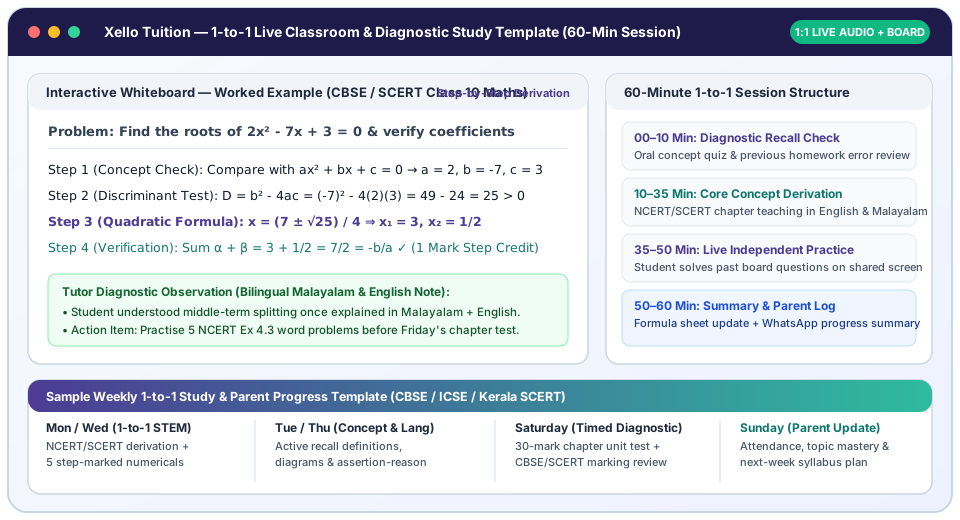
Worked Example: How We Structure a 60-Minute 1-to-1 Session
Every 60-minute 1-to-1 session is divided into four measurable classroom blocks so students actively solve problems rather than passively listening:
| Session Window | First-Hand Classroom Activity | What We Test & Verify |
|---|---|---|
| 00–10 Minutes | Prerequisite & Concept Recall Check | Oral quiz on previous formulas, definitions, and homework error patterns. |
| 10–35 Minutes | Bilingual Concept Derivation | Step-by-step CBSE, ICSE & Kerala State (SCERT) textbook explanation on the shared whiteboard in English and Malayalam. |
| 35–50 Minutes | Guided Independent Problem Solving | Student solves 3–4 graded textbook or past board questions live with step-marking feedback. |
| 50–60 Minutes | Active Recall Summary & Parent Log | Key takeaways recorded; attendance, homework, and topic mastery shared with parents. |
Copyable Template: Weekly 1-to-1 Study & Demo Evaluation Checklist
Parents and students can copy and use this weekly checklist to evaluate demo sessions and track chapter mastery:
WEEKLY 1-TO-1 STUDY & DEMO EVALUATION TEMPLATE (CBSE, ICSE & KERALA STATE (SCERT))
Student Class / Subject: KG to Class 12 — Arabic
Target School Chapter:   ____________________________________________

[ ] 1. Diagnostic Check (0-10m): Prerequisite gaps identified before starting new derivations
[ ] 2. Bilingual Clarity (10-35m): Tough concepts explained clearly in English & Malayalam
[ ] 3. Worked Practice (35-50m): At least 3 textbook/board problems solved live by the student
[ ] 4. Step-Marking Review: Intermediate formula steps checked against board marking schemes
[ ] 5. Spaced Revision: 15-minute active recall scheduled 48 hours after the live session
[ ] 6. Parent Progress Note: Weekly attendance, homework completion & unit-test score logged