
Key Takeaways & Quick Summary (TL;DR)
Key Takeaway: Xello Tuition provides personalized 1-to-1 live online classes for KG to Class 12 students studying Arabic under the CBSE, ICSE & Kerala State (SCERT) syllabus across UAE & Kerala, with bilingual English and Malayalam explanation and weekly parent progress tracking.
- Target Audience (Who This Is For): School students (KG to Class 12) and parents in UAE & Kerala (all 14 Kerala districts, UAE, Qatar, Saudi Arabia, Oman, Kuwait, and Bahrain).
- Supported Use Cases: Daily 1-to-1 live homework and textbook coaching, remedial concept recovery in Arabic, bilingual Malayalam and English explanation, and board exam preparation.
- Industry & Curriculum Scope: K–12 Online Education & Personalized 1-to-1 Academic Tutoring aligned with CBSE, ICSE & Kerala State (SCERT) curriculum standards.
- Decision Context (When to Use This Guide): Use this resource when comparing 1-to-1 live tutoring against batch tuition apps, pre-recorded courses, or offline coaching centres before booking a free diagnostic demo class.
Why Arabic is Difficult for Indian Students in UAE (And How to Fix It)
Here is a concise overview of Why Arabic is Difficult for Indian Students in UAE (And How to Fix It) for CBSE, ICSE, and Kerala State (SCERT) students studying Arabic with 1-to-1 live tutor support at Xello Tuition.
Looking to improve your grades? Join Xello Tuition — the best online tuition in Kerala for personalized 1-to-1 online tuition in Kerala from expert tutors.
For a clearer learning path, explore our online maths tuition classes, CBSE learning support, ICSE online classes, and Kerala State Syllabus tuition. Families outside India can also choose country-specific support for students in the UAE, Qatar, or Saudi Arabia.
style="font-size: 1.15rem; line-height: 1.8; color: #334155;">For thousands of Indian expatriates living in Dubai, Sharjah, and Abu Dhabi, ensuring their children excel in Indian curriculum schools (CBSE/ICSE) is a high priority. Yet, year after year, a singular subject consistently pulls down overall rankings: Arabic.
Parents often search intensely online, querying "why Arabic is hard for CBSE students", desperately looking for a tangible fix. If your child is struggling, understand this immediately: it is not a lack of effort. It is fundamentally a structural teaching disconnect. Here is exactly why Arabic difficulty for UAE students is so prevalent, and precisely how we fix it.
Does your child study in the Gulf? Finding a Malayalam-speaking Arabic tutor in the GCC is crucial for their academic success. Book a free demo class today!
1. The English-Arabic Translation Barrier
In most UAE schools, Ministry-mandated Arabic is taught using English as the bridge language. Unfortunately, English and Arabic have vastly different grammatical roots. Arabic utilizes deep root systems (usually three letters) from which words are generated. English lacks this entirely. When a teacher tries to explain Arabic grammar exclusively through English, an Indian student experiences massive cognitive overload. The syntax simply does not align.
2. Generational Disconnect (The Parent Factor)
Unlike Mathematics or Science where Indian parents can often step in to tutor their children at home, Arabic is an alien language for the vast majority of Malayali and Indian expatriate parents. You cannot assist with homework or verify the accuracy of a written assignment. The student is entirely isolated in their learning journey.
3. Gendered Grammar Complexity (Dual vs Dual)
Unlike English, where "they" is a plural catch-all, Arabic requires you to conjugate verbs completely differently depending on whether you are talking to a male, a female, a dual pair, or a plural group. For an Indian CBSE student memorizing formulas for biology, having to memorize 14 different pronoun conjugation structures for a single verb feels overwhelming.
The Powerful Fix: Mother-Tongue Learning
How do we overcome this immediately? By using Malayalam as the bridge language. Many grammatical structures in Malayalam possess similar logic trails to Middle Eastern languages. When our expert tutors at Xello Tuition UAE explain complex Arabic tenses directly in Malayalam, the "lightbulb" moment happens instantly for the student. Rote memorization stops, and genuine comprehension begins.
Actionable Steps to Elevate Grades
- Stop relying on generic online videos: They do not map to the UAE CBSE syllabus your school uses.
- Identify individual gaps: Instead of generalized conversational classes, diagnose whether the child is failing at vocabulary recall, verb conjugation, or reading speed.
- Hire a bilingual expert: Specifically, an Arabic tutor for Malayali students who can pinpoint the exact English-confusion points and override them safely with native Malayalam explanations.
If your child's overall aggregate percentage is suffering heavily because of their Arabic scores, you do not have time to experiment. You need targeted, 1-to-1 intervention. Check out our localized educational hubs designed to solve this crisis.
Discover Regional Academic Solutions:
Related Reading:
Tailored for UAE's Indian Expat Community
Our online tuition is fully aligned with CBSE and Kerala State curriculum guidelines followed by major Indian schools across the UAE (including KHDA-approved institutions). We understand the unique challenges of the expat student, offering flexible scheduling that perfectly aligns with Gulf Standard Time (GST). From Arabic second-language support to intense Science and Math coaching, our native Malayali tutors bridge the educational gap right from your home in the UAE.
First-Hand Classroom Experience: Worked Session Example & Study Template
In our 1-to-1 live classes at Xello Tuition (supporting KG to Class 12 students across CBSE, ICSE & Kerala State (SCERT) in UAE & Kerala), we test every student's baseline understanding before building a weekly study plan. Instead of passive one-way lectures, our academic team uses a structured 60-minute diagnostic and teaching workflow for Arabic.
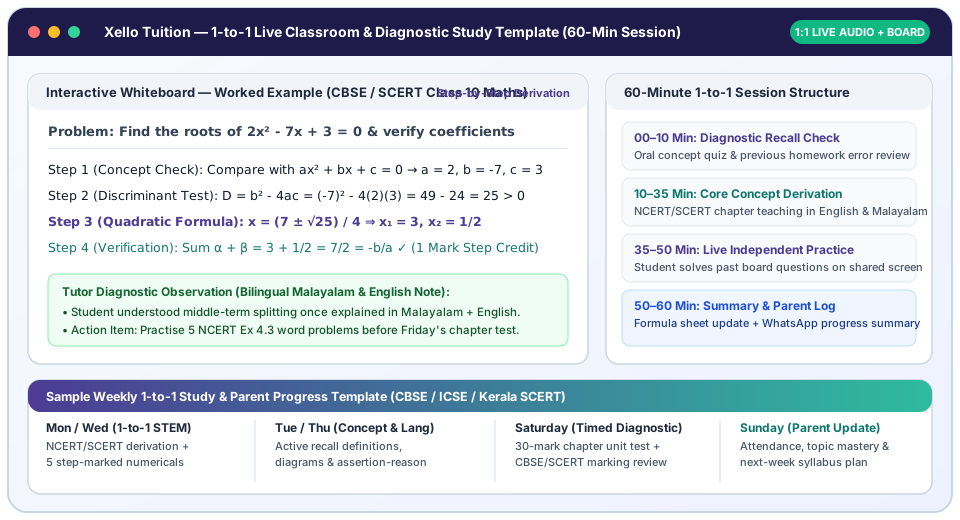
Worked Example: How We Structure a 60-Minute 1-to-1 Session
Every 60-minute 1-to-1 session is divided into four measurable classroom blocks so students actively solve problems rather than passively listening:
| Session Window | First-Hand Classroom Activity | What We Test & Verify |
|---|---|---|
| 00–10 Minutes | Prerequisite & Concept Recall Check | Oral quiz on previous formulas, definitions, and homework error patterns. |
| 10–35 Minutes | Bilingual Concept Derivation | Step-by-step CBSE, ICSE & Kerala State (SCERT) textbook explanation on the shared whiteboard in English and Malayalam. |
| 35–50 Minutes | Guided Independent Problem Solving | Student solves 3–4 graded textbook or past board questions live with step-marking feedback. |
| 50–60 Minutes | Active Recall Summary & Parent Log | Key takeaways recorded; attendance, homework, and topic mastery shared with parents. |
Copyable Template: Weekly 1-to-1 Study & Demo Evaluation Checklist
Parents and students can copy and use this weekly checklist to evaluate demo sessions and track chapter mastery:
WEEKLY 1-TO-1 STUDY & DEMO EVALUATION TEMPLATE (CBSE, ICSE & KERALA STATE (SCERT))
Student Class / Subject: KG to Class 12 — Arabic
Target School Chapter:   ____________________________________________

[ ] 1. Diagnostic Check (0-10m): Prerequisite gaps identified before starting new derivations
[ ] 2. Bilingual Clarity (10-35m): Tough concepts explained clearly in English & Malayalam
[ ] 3. Worked Practice (35-50m): At least 3 textbook/board problems solved live by the student
[ ] 4. Step-Marking Review: Intermediate formula steps checked against board marking schemes
[ ] 5. Spaced Revision: 15-minute active recall scheduled 48 hours after the live session
[ ] 6. Parent Progress Note: Weekly attendance, homework completion & unit-test score logged