
Class 2 is the year where the academic gap between children begins to widen for the first time. Students who mastered Class 1 phonics and basic numbers move ahead confidently, while those with small gaps find two-digit arithmetic and independent reading increasingly difficult. Here are 7 expert study tips to help every Class 2 student consolidate their foundations and move into Class 3 with confidence.
Key Takeaways & Quick Summary (TL;DR)
Key Takeaway: Xello Tuition provides personalized 1-to-1 live online classes for Class 2 students studying Mathematics, Science & Languages under the CBSE, ICSE & Kerala State (SCERT) syllabus across Kerala & the GCC, with bilingual English and Malayalam explanation and weekly parent progress tracking.
- Target Audience (Who This Is For): School students (Class 2) and parents in Kerala & the GCC (all 14 Kerala districts, UAE, Qatar, Saudi Arabia, Oman, Kuwait, and Bahrain).
- Supported Use Cases: Daily 1-to-1 live homework and textbook coaching, remedial concept recovery in Mathematics, Science & Languages, bilingual Malayalam and English explanation, and board exam preparation.
- Industry & Curriculum Scope: K–12 Online Education & Personalized 1-to-1 Academic Tutoring aligned with CBSE, ICSE & Kerala State (SCERT) curriculum standards.
- Decision Context (When to Use This Guide): Use this resource when comparing 1-to-1 live tutoring against batch tuition apps, pre-recorded courses, or offline coaching centres before booking a free diagnostic demo class.
1. Consolidate the Times Tables Before Class 3
Class 3 introduces multiplication — and students who have not developed strong number sense in Class 2 struggle with times tables immediately. Begin informal multiplication prep in Class 2 by skip-counting: count in 2s, 5s, and 10s during daily activities. This builds the mental number patterns that make formal multiplication tables in Class 3 feel like recognition rather than memorisation.
2. Move from Reading Aloud to Silent Reading
By the end of Class 2, children should be transitioning from reading aloud to reading silently with comprehension. Practice this by reading a paragraph together, then asking 2–3 questions about what happened. This builds the comprehension skills that carry through every exam in school — because the ability to read and understand a question is the first step to answering it correctly.
3. Practice Two-Digit Addition and Subtraction Daily
Class 2 introduces two-digit addition and subtraction with regrouping (carrying and borrowing). This is the first truly abstract Maths skill children encounter. Practice it daily with 5 problems — not as homework punishment, but as a quick "morning challenge." Familiarity with the process removes the anxiety that causes errors under test conditions.
4. Build Writing Stamina Gradually
Class 2 requires children to write full sentences independently for the first time — answers to questions, short descriptions, and simple sentences about pictures. Build writing stamina by asking your child to write 2–3 sentences about their day each evening. Focus on content, not perfection. Sentence writing fluency in Class 2 directly determines English performance in Classes 5 through 10.
5. Use EVS for Real-World Science Thinking
Class 2 EVS introduces concepts like food chains, water sources, and materials. Make these concrete by asking everyday questions: "Why does the ice cream melt?" "Where does rain come from?" These conversations build scientific thinking habits that distinguish strong Science students in Classes 6–10 — and it costs nothing but 5 minutes of conversation.
6. Review Class 1 Gaps Before They Compound
Many Class 2 struggles are actually unresolved Class 1 gaps. If your child is hesitant about two-digit numbers, the root issue is likely incomplete mastery of numbers 1–20 from Class 1. Spending 2 weeks revisiting Class 1 phonics or number concepts is more efficient than drilling Class 2 content that is built on those shaky foundations.
7. Make Homework a Routine, Not a Battle
Class 2 is the ideal year to establish the homework habit. Set a fixed time (same time every day), a fixed place (same quiet spot), and a fixed duration (30 minutes maximum). Homework resistance in Class 2 almost always dissolves within 2 weeks of consistent routine. The habit established now will still be functioning in Class 10.
Need expert help for this class?
Live 1-to-1 tuition with dedicated tutors for CBSE, ICSE & Kerala State Syllabus.
First-Hand Classroom Experience: Worked Session Example & Study Template
In our 1-to-1 live classes at Xello Tuition (supporting Class 2 students across CBSE, ICSE & Kerala State (SCERT) in Kerala & the GCC), we test every student's baseline understanding before building a weekly study plan. Instead of passive one-way lectures, our academic team uses a structured 60-minute diagnostic and teaching workflow for Mathematics, Science & Languages.
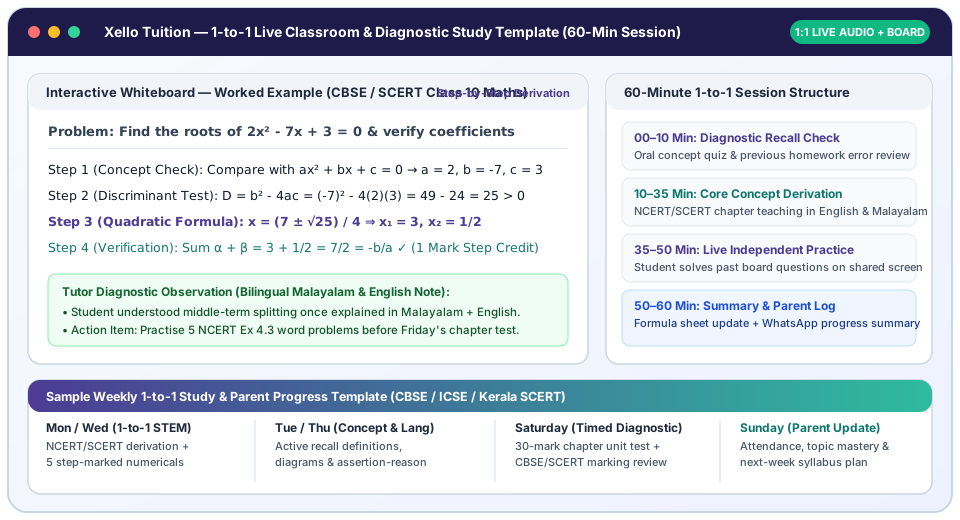
Worked Example: How We Structure a 60-Minute 1-to-1 Session
Every 60-minute 1-to-1 session is divided into four measurable classroom blocks so students actively solve problems rather than passively listening:
| Session Window | First-Hand Classroom Activity | What We Test & Verify |
|---|---|---|
| 00–10 Minutes | Prerequisite & Concept Recall Check | Oral quiz on previous formulas, definitions, and homework error patterns. |
| 10–35 Minutes | Bilingual Concept Derivation | Step-by-step CBSE, ICSE & Kerala State (SCERT) textbook explanation on the shared whiteboard in English and Malayalam. |
| 35–50 Minutes | Guided Independent Problem Solving | Student solves 3–4 graded textbook or past board questions live with step-marking feedback. |
| 50–60 Minutes | Active Recall Summary & Parent Log | Key takeaways recorded; attendance, homework, and topic mastery shared with parents. |
Copyable Template: Weekly 1-to-1 Study & Demo Evaluation Checklist
Parents and students can copy and use this weekly checklist to evaluate demo sessions and track chapter mastery:
WEEKLY 1-TO-1 STUDY & DEMO EVALUATION TEMPLATE (CBSE, ICSE & KERALA STATE (SCERT))
Student Class / Subject: Class 2 — Mathematics, Science & Languages
Target School Chapter:   ____________________________________________

[ ] 1. Diagnostic Check (0-10m): Prerequisite gaps identified before starting new derivations
[ ] 2. Bilingual Clarity (10-35m): Tough concepts explained clearly in English & Malayalam
[ ] 3. Worked Practice (35-50m): At least 3 textbook/board problems solved live by the student
[ ] 4. Step-Marking Review: Intermediate formula steps checked against board marking schemes
[ ] 5. Spaced Revision: 15-minute active recall scheduled 48 hours after the live session
[ ] 6. Parent Progress Note: Weekly attendance, homework completion & unit-test score logged