
Class 7 is the year when linear equations, rational numbers, and triangle geometry arrive simultaneously, and the Science syllabus expands significantly. It is also the year most commonly cited by Class 10 underperformers as "when Maths started getting hard." Here are 8 study tips that keep Class 7 students ahead of this curve rather than behind it.
Key Takeaways & Quick Summary (TL;DR)
Key Takeaway: Xello Tuition provides personalized 1-to-1 live online classes for Class 7 students studying Mathematics, Science & Languages under the CBSE, ICSE & Kerala State (SCERT) syllabus across Kerala & the GCC, with bilingual English and Malayalam explanation and weekly parent progress tracking.
- Target Audience (Who This Is For): School students (Class 7) and parents in Kerala & the GCC (all 14 Kerala districts, UAE, Qatar, Saudi Arabia, Oman, Kuwait, and Bahrain).
- Supported Use Cases: Daily 1-to-1 live homework and textbook coaching, remedial concept recovery in Mathematics, Science & Languages, bilingual Malayalam and English explanation, and board exam preparation.
- Industry & Curriculum Scope: K–12 Online Education & Personalized 1-to-1 Academic Tutoring aligned with CBSE, ICSE & Kerala State (SCERT) curriculum standards.
- Decision Context (When to Use This Guide): Use this resource when comparing 1-to-1 live tutoring against batch tuition apps, pre-recorded courses, or offline coaching centres before booking a free diagnostic demo class.
1. Master Linear Equations Before Moving to Any Other Topic
Linear equations in one variable are the single most important Class 7 topic — not just for Class 7, but for every Maths class through Class 10. If your child cannot confidently solve 2x + 5 = 13 in under 30 seconds, everything else in the Class 7 Maths curriculum will feel harder than it needs to. Spend the first two months of Class 7 exclusively mastering linear equations before diversifying study time.
2. Visualise Rational Numbers on a Number Line
Class 7 introduces rational numbers — fractions and their negative equivalents plotted on the number line. Students who struggle with this topic almost always have incomplete Class 6 integer understanding as the root cause. If your child finds rational numbers confusing, spend one week revisiting the integer number line from Class 6 before attempting rational number operations.
3. Draw Triangle Diagrams for Every Geometry Problem
Class 7 Geometry introduces triangle congruence, angle properties, and basic construction. The most common error is attempting to solve triangle problems without drawing a diagram. Make it a rule: never solve a geometry problem without first drawing and labelling the triangle. Students who habitually draw diagrams solve geometry problems 50% faster and make significantly fewer errors.
4. Group Science Topics by Study Method
Class 7 Science chapters require three different study methods depending on their type: diagram chapters (like the human digestive system) need drawing practice, chemistry chapters (acids and bases) need formula memorisation with examples, and ecology chapters (weather, soil) need conceptual reading and short notes. Identifying which method each chapter requires before studying it dramatically improves efficiency.
5. Build a Formula Sheet for Maths and Science
Class 7 introduces a significant number of formulas that carry through to Class 10 — perimeter of polygons, area of triangles, speed-time-distance relationships, and density formulas in Science. Build a single A4 formula sheet per subject, updating it as each new formula is introduced. Review this sheet weekly. Having all formulas in one place prevents the "I knew it but I forgot" error under exam pressure.
6. Start Attempting Previous Year Question Papers in Term 2
Most parents associate previous year question papers with Class 9 and 10 preparation. Starting this habit in Class 7 Term 2 gives students an enormous advantage — they learn what board-format questions look like 3 years early, develop time management skills, and identify specific topics that need more work without the pressure of board exam proximity.
7. Prioritise Understanding Over Completion
Class 7 marks the beginning of the "syllabus completion race" — students and parents focus on covering all chapters before exams rather than mastering each one. This approach consistently backfires by Class 9. A student who deeply understands 80% of the Class 7 syllabus outperforms one who superficially covers 100% of it, both in Class 7 exams and in every subsequent year.
8. Use 1-to-1 Tuition as a Diagnostic Tool, Not Just Remediation
Many parents start tuition only after their child starts failing. In Class 7, 1-to-1 tuition is even more valuable as a diagnostic tool — identifying which Class 6 gaps are causing current Class 7 difficulties before they compound further. Xello Tuition's first session includes a chapter-level diagnostic assessment that maps exactly which prior concepts need reinforcement.
Need expert help for this class?
Live 1-to-1 tuition with dedicated tutors for CBSE, ICSE & Kerala State Syllabus.
First-Hand Classroom Experience: Worked Session Example & Study Template
In our 1-to-1 live classes at Xello Tuition (supporting Class 7 students across CBSE, ICSE & Kerala State (SCERT) in Kerala & the GCC), we test every student's baseline understanding before building a weekly study plan. Instead of passive one-way lectures, our academic team uses a structured 60-minute diagnostic and teaching workflow for Mathematics, Science & Languages.
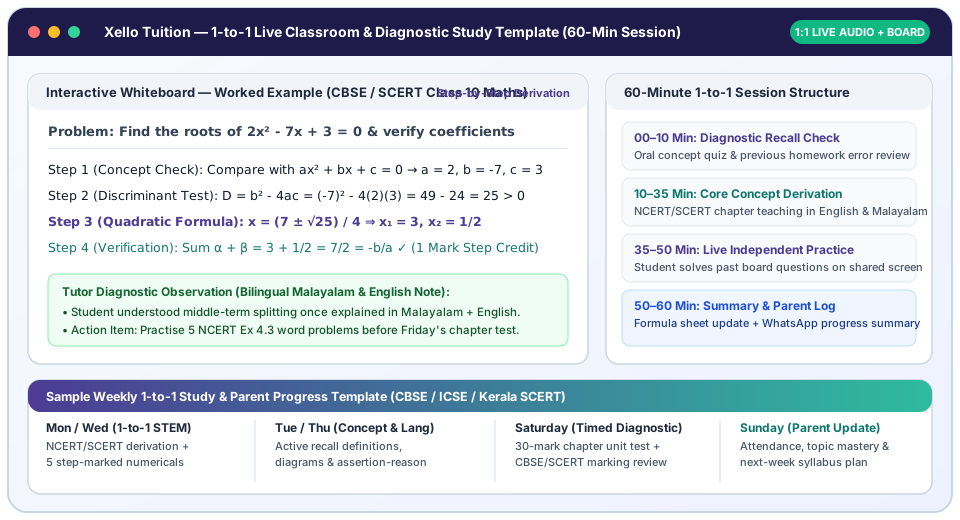
Worked Example: How We Structure a 60-Minute 1-to-1 Session
Every 60-minute 1-to-1 session is divided into four measurable classroom blocks so students actively solve problems rather than passively listening:
| Session Window | First-Hand Classroom Activity | What We Test & Verify |
|---|---|---|
| 00–10 Minutes | Prerequisite & Concept Recall Check | Oral quiz on previous formulas, definitions, and homework error patterns. |
| 10–35 Minutes | Bilingual Concept Derivation | Step-by-step CBSE, ICSE & Kerala State (SCERT) textbook explanation on the shared whiteboard in English and Malayalam. |
| 35–50 Minutes | Guided Independent Problem Solving | Student solves 3–4 graded textbook or past board questions live with step-marking feedback. |
| 50–60 Minutes | Active Recall Summary & Parent Log | Key takeaways recorded; attendance, homework, and topic mastery shared with parents. |
Copyable Template: Weekly 1-to-1 Study & Demo Evaluation Checklist
Parents and students can copy and use this weekly checklist to evaluate demo sessions and track chapter mastery:
WEEKLY 1-TO-1 STUDY & DEMO EVALUATION TEMPLATE (CBSE, ICSE & KERALA STATE (SCERT))
Student Class / Subject: Class 7 — Mathematics, Science & Languages
Target School Chapter:   ____________________________________________

[ ] 1. Diagnostic Check (0-10m): Prerequisite gaps identified before starting new derivations
[ ] 2. Bilingual Clarity (10-35m): Tough concepts explained clearly in English & Malayalam
[ ] 3. Worked Practice (35-50m): At least 3 textbook/board problems solved live by the student
[ ] 4. Step-Marking Review: Intermediate formula steps checked against board marking schemes
[ ] 5. Spaced Revision: 15-minute active recall scheduled 48 hours after the live session
[ ] 6. Parent Progress Note: Weekly attendance, homework completion & unit-test score logged