
Class 6 is statistically the year most students experience their first significant academic drop — and parents are often blindsided. A child who excelled in Class 5 suddenly struggles with algebra, negative numbers, and three separate Science streams. Here are 8 targeted study tips to help your Class 6 student navigate this critical transition year successfully.
Key Takeaways & Quick Summary (TL;DR)
Key Takeaway: Xello Tuition provides personalized 1-to-1 live online classes for Class 6 students studying Mathematics, Science & Languages under the CBSE, ICSE & Kerala State (SCERT) syllabus across Kerala & the GCC, with bilingual English and Malayalam explanation and weekly parent progress tracking.
- Target Audience (Who This Is For): School students (Class 6) and parents in Kerala & the GCC (all 14 Kerala districts, UAE, Qatar, Saudi Arabia, Oman, Kuwait, and Bahrain).
- Supported Use Cases: Daily 1-to-1 live homework and textbook coaching, remedial concept recovery in Mathematics, Science & Languages, bilingual Malayalam and English explanation, and board exam preparation.
- Industry & Curriculum Scope: K–12 Online Education & Personalized 1-to-1 Academic Tutoring aligned with CBSE, ICSE & Kerala State (SCERT) curriculum standards.
- Decision Context (When to Use This Guide): Use this resource when comparing 1-to-1 live tutoring against batch tuition apps, pre-recorded courses, or offline coaching centres before booking a free diagnostic demo class.
1. Treat Algebra as a New Language, Not an Extension of Arithmetic
The biggest Class 6 Maths mistake is treating algebra as harder arithmetic. Algebra is conceptually different — it introduces the idea that a number can be unknown. Help your child understand this: "I'm thinking of a number. When I add 5 to it, I get 12. What is the number?" This verbal framing of algebra helps children grasp variables before encountering the formal notation x + 5 = 12 in the textbook.
2. Build an Integer Number Line on the Bedroom Wall
Integers (positive and negative numbers) are new to Class 6 students and cause persistent confusion because negative numbers seem to violate everything a child has learned about numbers. A physical number line from -10 to +10 on the bedroom wall, referred to when doing homework, reduces integer errors by giving the abstract concept a visible, spatial reference.
3. Study Science by Stream, Not by Chapter
Class 6 Science textbooks interleave Physics, Chemistry, and Biology chapters. Many students study them in order without noticing the subject patterns. Instead, mentally categorise each chapter before starting: "Is this Physics, Chemistry, or Biology?" This stream-awareness builds the subject-specific thinking habits that are directly tested from Class 9 onwards.
4. Read Every Social Science Chapter Twice
Class 6 Social Science introduces History (earliest civilisations), Geography (earth, maps), and Civics simultaneously — three times the content of earlier Social Studies. Students who only skim these chapters once struggle with comprehension questions. Read each chapter once for story (narrative), then once for facts (names, dates, places). The second reading takes half the time and doubles retention.
5. Use Algebra to Check Arithmetic
A powerful Class 6 study habit: after solving any Maths problem, substitute your answer back to verify it. "x + 5 = 12, so x = 7. Does 7 + 5 = 12? Yes." This verification habit eliminates careless errors across all Maths topics from Class 6 through Class 10 and builds the mathematical precision that board examiners reward.
6. Do Not Skip Science Diagrams
Class 6 Science introduces several diagram-based questions — cell structures, parts of a plant, circuit diagrams. Many students skip drawing practice because it "takes too long." In reality, diagram questions are among the most predictable and highest-mark questions in Science papers from Class 6 to Class 10. Practice drawing and labelling each chapter's key diagram three times until it becomes automatic.
7. Build a Vocabulary List for Each Subject
Class 6 introduces subject-specific vocabulary that carries through Class 10 — "photosynthesis," "integer," "latitude," "democracy." Build a simple vocabulary notebook with one page per subject. When a new term appears, write the term, its simple definition, and one sentence using it. Reviewing this notebook for 5 minutes weekly builds the conceptual vocabulary that distinguishes high-scoring students.
8. Get Support for Algebra Before It Snowballs
Algebra gaps from Class 6 directly cause difficulties in Class 7 equations, Class 8 identities, Class 9 polynomials, and Class 10 board exams. If your child is confused by Class 6 algebra after 4 weeks of school, early 1-to-1 tuition is the most efficient intervention. Xello Tuition's Class 6 sessions rebuild algebraic thinking from concept level — not just procedure memorisation.
Need expert help for this class?
Live 1-to-1 tuition with dedicated tutors for CBSE, ICSE & Kerala State Syllabus.
First-Hand Classroom Experience: Worked Session Example & Study Template
In our 1-to-1 live classes at Xello Tuition (supporting Class 6 students across CBSE, ICSE & Kerala State (SCERT) in Kerala & the GCC), we test every student's baseline understanding before building a weekly study plan. Instead of passive one-way lectures, our academic team uses a structured 60-minute diagnostic and teaching workflow for Mathematics, Science & Languages.
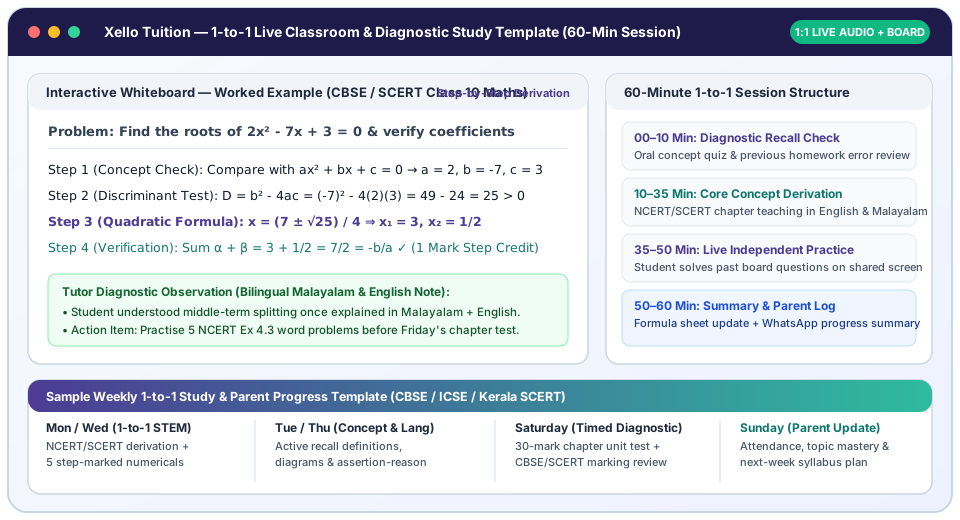
Worked Example: How We Structure a 60-Minute 1-to-1 Session
Every 60-minute 1-to-1 session is divided into four measurable classroom blocks so students actively solve problems rather than passively listening:
| Session Window | First-Hand Classroom Activity | What We Test & Verify |
|---|---|---|
| 00–10 Minutes | Prerequisite & Concept Recall Check | Oral quiz on previous formulas, definitions, and homework error patterns. |
| 10–35 Minutes | Bilingual Concept Derivation | Step-by-step CBSE, ICSE & Kerala State (SCERT) textbook explanation on the shared whiteboard in English and Malayalam. |
| 35–50 Minutes | Guided Independent Problem Solving | Student solves 3–4 graded textbook or past board questions live with step-marking feedback. |
| 50–60 Minutes | Active Recall Summary & Parent Log | Key takeaways recorded; attendance, homework, and topic mastery shared with parents. |
Copyable Template: Weekly 1-to-1 Study & Demo Evaluation Checklist
Parents and students can copy and use this weekly checklist to evaluate demo sessions and track chapter mastery:
WEEKLY 1-TO-1 STUDY & DEMO EVALUATION TEMPLATE (CBSE, ICSE & KERALA STATE (SCERT))
Student Class / Subject: Class 6 — Mathematics, Science & Languages
Target School Chapter:   ____________________________________________

[ ] 1. Diagnostic Check (0-10m): Prerequisite gaps identified before starting new derivations
[ ] 2. Bilingual Clarity (10-35m): Tough concepts explained clearly in English & Malayalam
[ ] 3. Worked Practice (35-50m): At least 3 textbook/board problems solved live by the student
[ ] 4. Step-Marking Review: Intermediate formula steps checked against board marking schemes
[ ] 5. Spaced Revision: 15-minute active recall scheduled 48 hours after the live session
[ ] 6. Parent Progress Note: Weekly attendance, homework completion & unit-test score logged