
Class 4 is the upper primary transition year — and the first year where fractions, long division, and a genuinely demanding Science syllabus arrive together. Students who navigate Class 4 well enter Class 5 with real academic confidence. Those who struggle tend to carry those specific weaknesses all the way to the board exam. Here are 7 targeted study tips for Class 4 success.
Key Takeaways & Quick Summary (TL;DR)
Key Takeaway: Xello Tuition provides personalized 1-to-1 live online classes for Class 4 students studying Mathematics, Science & Languages under the CBSE, ICSE & Kerala State (SCERT) syllabus across Kerala & the GCC, with bilingual English and Malayalam explanation and weekly parent progress tracking.
- Target Audience (Who This Is For): School students (Class 4) and parents in Kerala & the GCC (all 14 Kerala districts, UAE, Qatar, Saudi Arabia, Oman, Kuwait, and Bahrain).
- Supported Use Cases: Daily 1-to-1 live homework and textbook coaching, remedial concept recovery in Mathematics, Science & Languages, bilingual Malayalam and English explanation, and board exam preparation.
- Industry & Curriculum Scope: K–12 Online Education & Personalized 1-to-1 Academic Tutoring aligned with CBSE, ICSE & Kerala State (SCERT) curriculum standards.
- Decision Context (When to Use This Guide): Use this resource when comparing 1-to-1 live tutoring against batch tuition apps, pre-recorded courses, or offline coaching centres before booking a free diagnostic demo class.
1. Teach Fractions Visually Before Abstractly
Fractions are the most feared Class 4 topic — and the most consequential for future learning. Before introducing any fraction notation, spend one week making fractions visual: cut a piece of paper into halves, quarters, and thirds. Show that 1/2 of a pizza is bigger than 1/4. This conceptual foundation makes the formal fraction notation and operations that follow far more intuitive and far less prone to error.
2. Connect Long Division to Real-Life Problems
Long division is the Class 4 procedure most children find tedious and confusing. Make it relevant: "We have 96 sweets to share equally among 8 children — how many does each get?" Real-world context activates problem-solving instinct, which is more powerful than the algorithm alone. Practice 3–4 division problems daily in context until the procedure becomes automatic.
3. Build Science Answer-Writing Skills Early
Class 4 Science introduces the habit of writing answers in full sentences — "The process by which plants make food is called photosynthesis." Many children know the answer but lose marks because they write it as a single word. Spend 5 minutes after every Science topic practicing the full-sentence answer format. This habit is worth 15–20 marks across every Science exam from Class 4 to Class 10.
4. Use Maps as Geography Learning Tools
Class 4 Social Studies introduces map reading, India's states, and community topics. Instead of memorising from the textbook, buy a simple India map poster and point to states during family conversations about news or cricket. Geography knowledge built through association with real events sticks far more reliably than textbook-based rote memorisation.
5. Preview Class 5 Decimals at the End of Year
Class 5 introduces decimals, which build directly on Class 4 fractions. In the last 4 weeks of Class 4, introduce the concept that 1/2 = 0.5 and 1/4 = 0.25 through practical examples — price tags, measurement markings. Students who arrive in Class 5 with this decimal-fraction connection already formed find the Class 5 Maths significantly more manageable.
6. Prioritise Weakest Subjects for Dedicated Sessions
Class 4 typically reveals a child's subject profile for the first time — they tend to be clearly stronger in either language or Maths. If your child is Maths-weak, allocate extra session time to fractions and division specifically. If language-weak, spend additional time on paragraph writing and grammar. Covering everything equally is less effective than targeting the subjects that most need attention.
7. Use the Textbook as the Primary Study Material
Many Class 4 parents supplement heavily with workbooks and guides. For Class 4, the NCERT or SCERT textbook contains everything the school will test. Read each chapter fully, complete all exercises in the textbook, and only use supplementary materials for extra practice on specific topics your child finds difficult. Textbook mastery in Class 4 prevents the gap between school teaching and tuition content.
Need expert help for this class?
Live 1-to-1 tuition with dedicated tutors for CBSE, ICSE & Kerala State Syllabus.
First-Hand Classroom Experience: Worked Session Example & Study Template
In our 1-to-1 live classes at Xello Tuition (supporting Class 4 students across CBSE, ICSE & Kerala State (SCERT) in Kerala & the GCC), we test every student's baseline understanding before building a weekly study plan. Instead of passive one-way lectures, our academic team uses a structured 60-minute diagnostic and teaching workflow for Mathematics, Science & Languages.
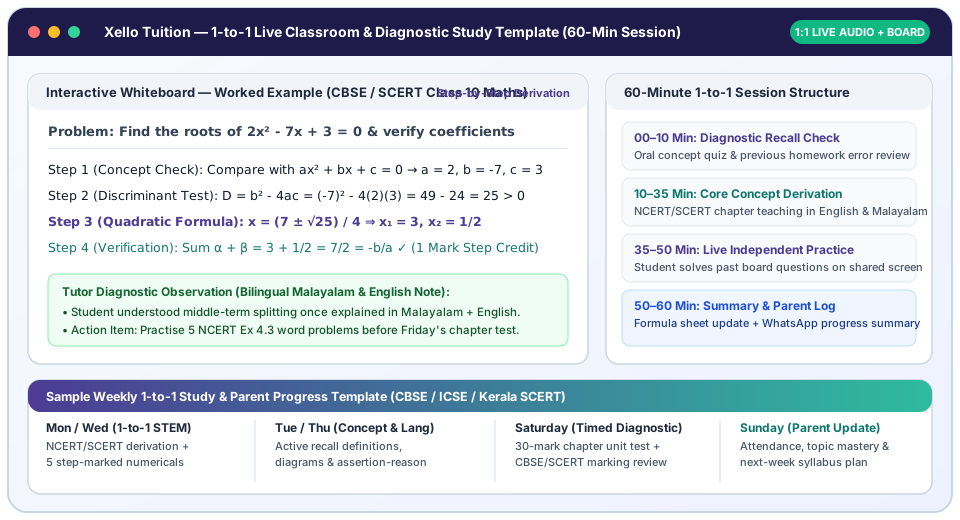
Worked Example: How We Structure a 60-Minute 1-to-1 Session
Every 60-minute 1-to-1 session is divided into four measurable classroom blocks so students actively solve problems rather than passively listening:
| Session Window | First-Hand Classroom Activity | What We Test & Verify |
|---|---|---|
| 00–10 Minutes | Prerequisite & Concept Recall Check | Oral quiz on previous formulas, definitions, and homework error patterns. |
| 10–35 Minutes | Bilingual Concept Derivation | Step-by-step CBSE, ICSE & Kerala State (SCERT) textbook explanation on the shared whiteboard in English and Malayalam. |
| 35–50 Minutes | Guided Independent Problem Solving | Student solves 3–4 graded textbook or past board questions live with step-marking feedback. |
| 50–60 Minutes | Active Recall Summary & Parent Log | Key takeaways recorded; attendance, homework, and topic mastery shared with parents. |
Copyable Template: Weekly 1-to-1 Study & Demo Evaluation Checklist
Parents and students can copy and use this weekly checklist to evaluate demo sessions and track chapter mastery:
WEEKLY 1-TO-1 STUDY & DEMO EVALUATION TEMPLATE (CBSE, ICSE & KERALA STATE (SCERT))
Student Class / Subject: Class 4 — Mathematics, Science & Languages
Target School Chapter:   ____________________________________________

[ ] 1. Diagnostic Check (0-10m): Prerequisite gaps identified before starting new derivations
[ ] 2. Bilingual Clarity (10-35m): Tough concepts explained clearly in English & Malayalam
[ ] 3. Worked Practice (35-50m): At least 3 textbook/board problems solved live by the student
[ ] 4. Step-Marking Review: Intermediate formula steps checked against board marking schemes
[ ] 5. Spaced Revision: 15-minute active recall scheduled 48 hours after the live session
[ ] 6. Parent Progress Note: Weekly attendance, homework completion & unit-test score logged