
Class 9 is the most strategically important year in the entire school journey. Every topic taught in Class 9 — polynomials, coordinate geometry, triangles, laws of motion, atoms and molecules — appears directly in the Class 10 board exam at a harder level. Students who master Class 9 with depth consistently outperform those who rush through it in the board exam. Here are 9 expert study tips to use every month of Class 9.
Key Takeaways & Quick Summary (TL;DR)
Key Takeaway: Xello Tuition provides personalized 1-to-1 live online classes for Class 9 students studying Mathematics, Science & Languages under the CBSE, ICSE & Kerala State (SCERT) syllabus across Kerala & the GCC, with bilingual English and Malayalam explanation and weekly parent progress tracking.
- Target Audience (Who This Is For): School students (Class 9) and parents in Kerala & the GCC (all 14 Kerala districts, UAE, Qatar, Saudi Arabia, Oman, Kuwait, and Bahrain).
- Supported Use Cases: Daily 1-to-1 live homework and textbook coaching, remedial concept recovery in Mathematics, Science & Languages, bilingual Malayalam and English explanation, and board exam preparation.
- Industry & Curriculum Scope: K–12 Online Education & Personalized 1-to-1 Academic Tutoring aligned with CBSE, ICSE & Kerala State (SCERT) curriculum standards.
- Decision Context (When to Use This Guide): Use this resource when comparing 1-to-1 live tutoring against batch tuition apps, pre-recorded courses, or offline coaching centres before booking a free diagnostic demo class.
1. Treat Class 9 as the First Year of Board Preparation
Most students begin board preparation in Class 10. The students who score 90%+ in Class 10 boards are almost always those who began in Class 9. Treat every Class 9 exam as board preparation, not just a school test. This mindset shift — from "just passing Class 9" to "building board exam readiness" — is the single most impactful study strategy available at this stage.
2. Master Polynomials Before Any Other Class 9 Maths Topic
Class 9 Maths begins with polynomials — degree, factors, remainder theorem, and factor theorem. These concepts underpin algebraic identities (a+b+c)², difference of cubes, and Class 10 quadratic equations. Students who deeply understand Class 9 polynomials find the Class 10 algebra chapters feel like revision. Students who skip through polynomials struggle with Class 10 Algebra from the very first chapter.
3. Use Coordinate Geometry to Make Algebra Visual
Class 9 introduces coordinate geometry — plotting points, understanding axes, and the foundations of lines and gradients. This is the bridge between abstract algebra and visual geometry. Practice plotting points daily for 2 weeks at the start of the coordinate geometry chapter. The spatial intuition developed here directly supports Class 10 graphing and Class 10 coordinate geometry theorems.
4. Study Triangle Theorems with Formal Proofs
Class 9 Geometry introduces congruence of triangles and their formal proofs. Many students memorise the SAS, SSS, AAS, and RHS rules without understanding why they work. Understanding the proofs makes the rules permanent and applicable to the unfamiliar triangle problems that appear in board exams. Spend one dedicated session per triangle theorem learning the proof, not just the rule.
5. Map Every Class 9 Science Topic to Its Class 10 Application
This is the most powerful Class 9 study technique: after finishing any Science chapter, look up which Class 10 chapter it connects to. Matter in Our Surroundings → Class 10 Chemical Reactions. Laws of Motion → Class 10 Electricity. Atoms and Molecules → Class 10 Carbon Compounds. This mapping transforms Class 9 Science revision into Class 10 preview work, making exam preparation feel cumulative rather than starting from scratch.
6. Solve At Least One Class 10 Past Paper in December
Solve a full Class 10 board paper in December of Class 9 — cold, without preparation. This sounds extreme but serves a precise purpose: it shows you exactly which Class 9 topics are most important for boards, and which Class 8 gaps you still need to close. The 3-hour experience under board conditions at this early stage is more revealing and less stressful than the same paper attempted in October of Class 10.
7. Write Answers in Board Format from the First Class 9 Exam
Board examiners award marks for how answers are written, not just whether they are correct. Class 9 is the year to establish the board answer format: state the formula or rule, show the substitution, show working steps, box the final answer. Teachers in Class 9 school exams rarely deduct marks for format — but practising this format now means it becomes automatic under Class 10 board pressure.
8. Build a Dedicated Notebook for Formulas and Definitions
Class 9 introduces the highest density of new formulas and definitions in any school year — Maths, Physics, Chemistry, and Biology all simultaneously. One A4 notebook divided into four sections (one per subject), updated as each new formula or definition appears, reviewed weekly, becomes the most efficient last-minute revision tool for both Class 9 exams and Class 10 boards.
9. Enrol in 1-to-1 Tuition for Weakest Subject By October
The largest Class 10 board exam improvement stories almost always involve a student who started targeted 1-to-1 tuition in their weakest subject in Class 9 — not Class 10. By October of Class 9, parents can identify which subject needs the most work based on Term 1 results. Acting in Class 9 gives 12 months of compound improvement before the board exam; acting in Class 10 gives 6 or fewer.
Need expert help for this class?
Live 1-to-1 tuition with dedicated tutors for CBSE, ICSE & Kerala State Syllabus.
First-Hand Classroom Experience: Worked Session Example & Study Template
In our 1-to-1 live classes at Xello Tuition (supporting Class 9 students across CBSE, ICSE & Kerala State (SCERT) in Kerala & the GCC), we test every student's baseline understanding before building a weekly study plan. Instead of passive one-way lectures, our academic team uses a structured 60-minute diagnostic and teaching workflow for Mathematics, Science & Languages.
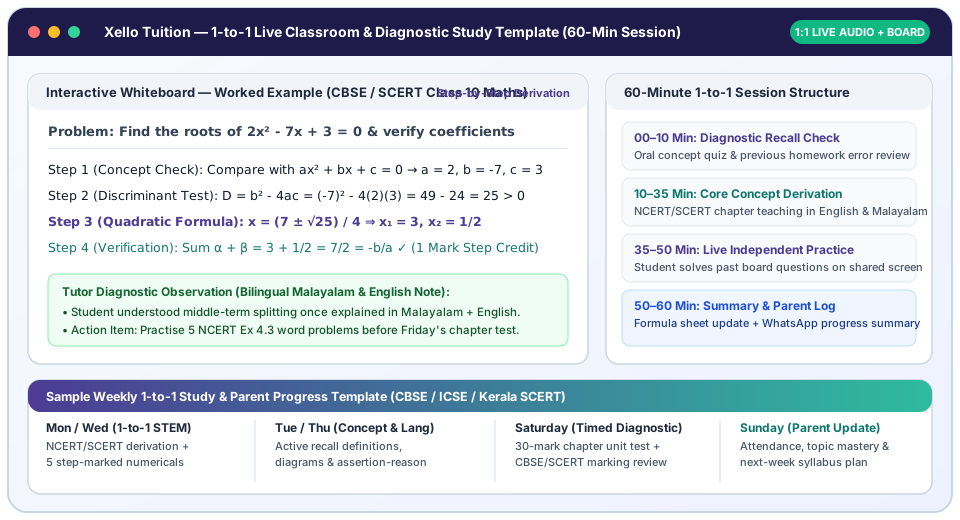
Worked Example: How We Structure a 60-Minute 1-to-1 Session
Every 60-minute 1-to-1 session is divided into four measurable classroom blocks so students actively solve problems rather than passively listening:
| Session Window | First-Hand Classroom Activity | What We Test & Verify |
|---|---|---|
| 00–10 Minutes | Prerequisite & Concept Recall Check | Oral quiz on previous formulas, definitions, and homework error patterns. |
| 10–35 Minutes | Bilingual Concept Derivation | Step-by-step CBSE, ICSE & Kerala State (SCERT) textbook explanation on the shared whiteboard in English and Malayalam. |
| 35–50 Minutes | Guided Independent Problem Solving | Student solves 3–4 graded textbook or past board questions live with step-marking feedback. |
| 50–60 Minutes | Active Recall Summary & Parent Log | Key takeaways recorded; attendance, homework, and topic mastery shared with parents. |
Copyable Template: Weekly 1-to-1 Study & Demo Evaluation Checklist
Parents and students can copy and use this weekly checklist to evaluate demo sessions and track chapter mastery:
WEEKLY 1-TO-1 STUDY & DEMO EVALUATION TEMPLATE (CBSE, ICSE & KERALA STATE (SCERT))
Student Class / Subject: Class 9 — Mathematics, Science & Languages
Target School Chapter:   ____________________________________________

[ ] 1. Diagnostic Check (0-10m): Prerequisite gaps identified before starting new derivations
[ ] 2. Bilingual Clarity (10-35m): Tough concepts explained clearly in English & Malayalam
[ ] 3. Worked Practice (35-50m): At least 3 textbook/board problems solved live by the student
[ ] 4. Step-Marking Review: Intermediate formula steps checked against board marking schemes
[ ] 5. Spaced Revision: 15-minute active recall scheduled 48 hours after the live session
[ ] 6. Parent Progress Note: Weekly attendance, homework completion & unit-test score logged